On or about the date in question
Supreme Court releases reasons why a prosecutor doesn’t have to prove the timing of a criminal offence beyond a reasonable doubt
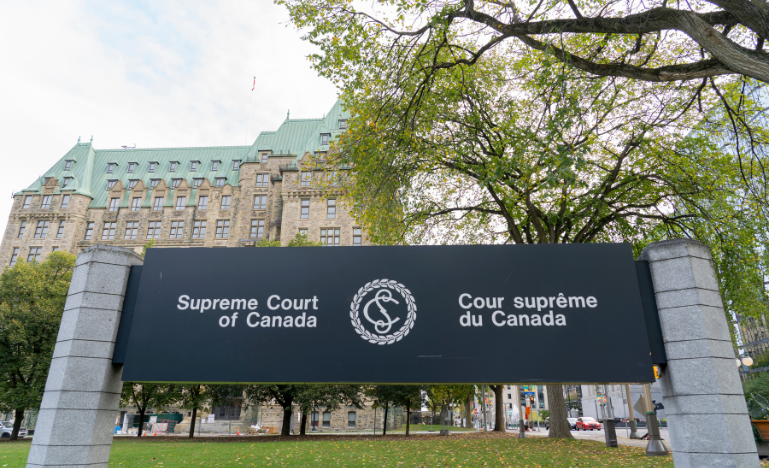
The Supreme Court of Canada has laid out the reasons why a prosecutor doesn’t have to prove the timing of a criminal offence beyond a reasonable doubt.
In dismissing the appeal of a sexual assault conviction, the Court, writing as a whole, was to the point, taking just 14 paragraphs to explain its decision.
The case relates to a couple’s final night together in their marital home before separating. The complainant, who was the spouse of the accused, GG, at the time, was sexually assaulted on April 7, 2021, in her bedroom. GG acknowledged the sexual activity, but claimed it was consensual.
The timing of the assault became the issue in question at trial.
The trial judge believed the assault occurred as the complainant described. However, under cross-examination, she stated that it happened at approximately 10 or 11 pm that night. GG testified they’d had intercourse nearly twenty-four hours earlier, and on April 7, he left the home at 9 pm and stayed at a different residence. He produced an alibi to that effect.
The judge ruled that because the Crown could not prove beyond a reasonable doubt that the assault occurred within the time period described by the complainant, he needed to enter an acquittal.
This was overturned at the Ontario Court of Appeal, which found the trial judge erred by requiring proof of the timing of the offence to that level of specificity. The Court set aside the acquittal and substituted a conviction based on the trial judge’s finding that the assault occurred as described. It remanded the matter back to the trial court for sentencing.
An appeal of this decision was dismissed by the Supreme Court at the bench.
In its written reasons, the Court said an indictment will allege an offence was committed “on or about” a particular date or range of dates. The Crown is generally not required to establish the exact timing of the offence with two exceptions—where the date or time is an essential element of the offence, or where it’s crucial to the defence.
“It would be unfair for the Crown to undermine the alibi by shifting to a different time frame and claiming that the offence was committed at a different time,” the Court wrote.
“Whether the Crown has shifted the alleged time frame in a manner that undermines trial fairness must be assessed holistically and contextually, rather than by focusing narrowly on when a witness said they think the offence may have taken place. This is especially important in sexual assault cases, where it is not uncommon for complainants to be uncertain or honestly mistaken about the specific date or time the alleged offence took place.”
The Court also noted that even though a time frame was given during cross-examination, the Crown never claimed that the assault occurred at that time. Substituting a conviction was the appropriate remedy in this case because the findings of fact supported a conviction beyond a reasonable doubt.
Kyla Lee of Acumen Law in Vancouver, and a former chair of the CBA’s criminal justice section, says the ruling doesn’t really provide much help for courts or lawyers.
“Part of why the Supreme Court of Canada hears cases is because they’re of national importance,” she says.
“They want to give information to the profession and to judges about how legal tests are going to be applied, but this judgment leaves less predictability than would be desired, and what was being asked for in the arguments.”
She’s disappointed by the lack of guidance about exactly when a point in time becomes relevant to alibi evidence, particularly when the Crown’s theory of the case may not be apparent to the trier of fact or the defence.
“How do you make that decision about what an accused is responding to without knowing how the evidence is going to come out at trial, without a judge knowing what was disclosed to you, and what you’re prepared to respond to?”
Lee says the Court took the easy way out by not providing a legal test to determine when the Crown shifts time frames in an impermissible manner, instead simply stating that it is holistic and contextual.
Michael Spratt, a partner with AGP LLP in Ottawa, says the Court likely felt it important to provide written reasons in this case because sexually-based offences need to be treated very seriously.
“Courts need to be precise and communicative about the rules, the reasoning and the rationale behind decisions and those principles that underpin the criminal justice system,” he says.
“That’s important because the public needs to know when someone’s acquitted, even when they disagree with the decision. Or when it’s a decision that flows from the strict application of proof beyond a reasonable doubt — when something probably happened but the court can’t be sure that it did.”
Spratt says there needs to be public confidence in court decisions, and part of that is acknowledging when fundamental mistakes were made.
“It’s important that our courts are communicative and definitive about that. In this case, when the Supreme Court speaks, they make sure there is no room for disagreement and to ensure there is national applicability for it,” he says.
“It’s important that the public can see and understand that.”
That’s particularly true when there’s an acquittal based on the principle of proof beyond a reasonable doubt or other reasons that the public may be confused or dubious about.
“We need to be sure that we’re clear in all circumstances so the public has confidence in our courts.”