Justice Sheilah Martin leaving the Supreme Court
No reason given for her early departure in May
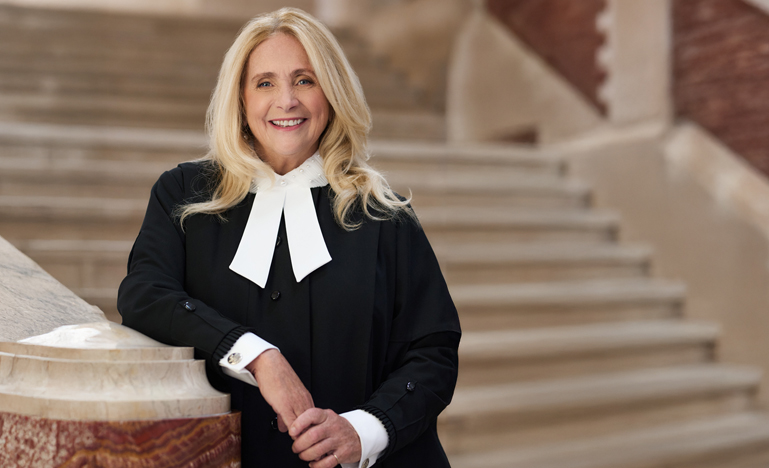
Justice Sheilah Martin is leaving the Supreme Court of Canada.
In a news release Tuesday, Chief Justice Richard Wagner announced Martin intends to step down on May 30 — a day before her 70th birthday. No reason was offered for the early retirement. Martin would have been eligible to serve another five years on the Court.
“I am deeply grateful for the opportunity to have served Canadians on our nation’s apex court. It has been an honour and a highlight of my professional life,” she said in a statement.
“I am forever thankful for the precious opportunity it provided to better understand the richness and diversity of the people in our country and the laws and institutions that allow us to live together with respect, dignity and equality.”
She added that in addition to the need for a strong and independent judiciary to address issues of national importance, she has also been happy to take part in the Court’s outreach activities and educational endeavours.
Martin was born and raised in Montréal, and trained in both common and civil law before moving to Alberta, where her career included private practice and academia. She served as the dean of the University of Calgary’s Faculty of Law before being appointed to the bench in 2005. She initially sat on the Court of Queen’s Bench (now Court of King’s Bench), before moving on to the Courts of Appeal of Alberta, the Northwest Territories, and Nunavut. She was appointed to the Supreme Court of Canada on December 18, 2017.
“Justice Martin is widely respected for the depth of her legal scholarship, her commitment to fairness, and her principled approach to justice,” Wagner said in his release.
“She has made remarkable contributions to Canadian jurisprudence, and her commitment to education has carried over into her career on the bench.”
He also noted that she was the first Supreme Court judge he swore in as chief justice and has always “appreciated her enthusiasm in supporting initiatives that promote openness, transparency and meaningful engagement with Canadians.”
“Her colleagues and I wish her a very happy retirement,” Wagner added.
The opening created by Martin’s departure will be Prime Minister Mark Carney’s first appointment to the Supreme Court of Canada. No process has been announced for the selection.
The benefit of a diverse background
University of Waterloo professor Emmett Macfarlane, who studies the Court and has written the book Governing from the Bench, says an early retirement is not that unusual for the Supreme Court of Canada.
He says Martin has been one of the country’s better judges over the past couple of decades.
“She is a great example of a judge who shows the benefit of a diverse background,” Macfarlane says.
“She has experience in practice but also spent considerable time as an academic and has published scholarly work and served in various roles before becoming a judge. Unlike some judges with academic backgrounds, she often strove for clarity of thinking, and I think she is really well respected within the legal community.”
In his opinion, Martin has made significant contributions to the Court’s criminal law jurisprudence and will be deeply missed.
“Some of the reasons that she wrote were some really big cases, such as consent in the context of sexual assault cases, and some of the sentencing penalties that the Court struck down,” he says.
“She was certainly serving a role on the Court in that respect.”
Nadia Effendi, a partner with Borden Ladner Gervais LLP, has always appreciated that from the beginning, Martin was genuine in her desire to understand the difficult issues the Court was facing from the parties and counsel.
While she says Martin’s decision to step down is surprising, she’s been an important member of the Court and will be remembered for her sense of fairness and defence of the vulnerable.
“In the first decision she authored, Boudreault, related to mandatory victims surcharges, she found that it constituted cruel and unusual punishment,” Effendi says.
“It set the tone for some of her judgments, and it has been cited since with section 12 cases.”
As a French speaker, Effendi also appreciated Martin's co-authorship of the Bessette decision. It found that anyone charged with a provincial offence in British Columbia has the right to a trial in either English or French, just as in a criminal trial, which was significant for the francophone community.
“For me, that was a big deal. She really appreciated that she had a role to play there.”
'An emphasis on fairness and real-world impact'
Marie-France Major, a partner with Supreme Advocacy LLP in Ottawa, says Martin will leave a significant legacy as a careful and principled jurist. As the replacement for former Chief Justice McLachlin on the bench, she quickly took on a similar role as a consensus-builder.
“Although her professional background was rooted in criminal and constitutional law, she demonstrated real breadth by contributing reasons across a range of areas, including family law, immigration, contract law and torts,” Major says.
“She is a notably clear writer. A consistent through-line in her work is an emphasis on fairness and the real-world impact of legal principles, ensuring that the people at the centre of a case weren’t forgotten.”

.png?ext=.png)