Search underway to replace SCC Justice Sheilah Martin
Despite calls by some premiers for more involvement in selecting judges, the process remains similar to what’s been used for recent top court appointments
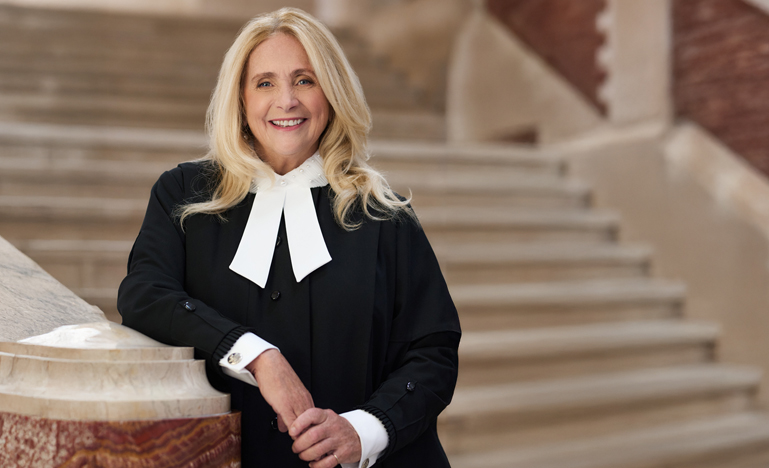
Prime Minister Mark Carney recently announced that the process to appoint the next Supreme Court of Canada justice had been launched.
The process is similar to that used by his predecessor, Justin Trudeau, and will see prospective new justices submit an application to an independent advisory board, whose composition and chair have yet to be named.
Justice Sheilah Martin announced in January that she will be resigning as of May 30, at the end of the Court’s spring session. She will be vacating one of the western seats on the bench, so the process is open to qualified applicants from western and northern Canada. Applicants have until April 27 to submit their package to the board.
Reducing opportunities for partisanship
Emmett Macfarlane, a political science professor at the University of Waterloo and a scholar of the Court, says that carrying on with the Trudeau model is a positive decision.
“Anything that reduces the opportunities for partisanship over appointments is crucial, especially in the current climate, as we’re seeing strong pushes from certain provincial premiers seeking to politicize the process,” he says, noting that the composition of the panel can add a layer of protection against partisanship and polarization of appointments.
CBA president Bianca Kratt recently wrote to the prime minister, urging him to resist efforts to politicize judicial appointments.
“Public confidence will not be bolstered, and diversity will not be enhanced, by replacing a merit-based, relatively apolitical process with provincial government vetoes,” she wrote.
Ian Holloway, a law professor and former dean at the University of Calgary, agrees that the decision to retain this appointment model is good overall. It has worked well and will involve input from the region in question.
“Bravo to the prime minister for carrying on.”
That said, Macfarlane would like to see a model that doesn’t solely focus on applications. Instead, he’d rather see the advisory body proactively reach out to prospective candidates and have a conversation about being considered.
“I’m not sure that people seeking to climb the ladder should be the only ones considered,” he says.
“I’d love to see people called upon to serve their country with this kind of spot on the highest court in the land. We produced a lot of good candidates under the old system despite its lack of transparency. Why can’t we do this with this arm’s-length body?”
Avoiding a circus
Since the time of former Prime Minister Paul Martin, the appointment process has seen increased parliamentary involvement. That’s come in the form of a nominee meeting and an ad hoc parliamentary committee of MPs and senators to answer questions, with limits on what can be asked.
Macfarlane notes that going back to 2006, when both Martin and Stephen Harper sought greater parliamentary involvement, there was concern from the former chief justice, as well as the CBA and law societies, that this could lead to inappropriate politicization of the process and negatively impact the public’s perception of the nominee if they faced a barrage of negative questions.
“Those fears failed to materialize, and the legal community and many of the judges who have gone through the process have come to accept it as a relatively benign exercise,” he says.
“It could be improved, but we want to be careful not to turn it into an avenue for partisan theatre.”
Holloway agrees that caution has always been warranted when involving parliamentarians.
“You’d have to be naïve to say that there’s no politics involved now. Clearly, there is. But where we don’t want to get to is the kind of clown show that they have in the United States,” he says.
“The reality is that parliamentary self-discipline is the only thing stopping this from devolving into a spectacle. All it will take is for one angry or media-seeking MP to ask some American-style questions, and there we’ll be.”
Macfarlane says the quality of the questions asked has been his biggest concern. Avoiding the partisan circus of the U.S. means avoiding making it a parliamentary confirmation vote. Questions can be improved by requiring them to relate to the questionnaire that candidates have been asked to answer in recent years. That is focused on their philosophy of judging and their understanding of the Constitution. It’s possible to ask more substantive questions without getting into the dangers of asking appointees about specific cases.
He can only think of a couple of instances during past hearings of inappropriate questions, one of which involved the outrage over Michael Moldaver’s lack of French fluency.
“The person answerable for the appointment is ultimately the prime minister and not the individual judge,” Macfarlane says.
“There were some inappropriate questions … that seemed to be attacking the judge who took the job based on the eligibility criteria of the time, and who was promising to improve his French competency.”
Ambiguity around parliamentary involvement
Ultimately, while the process has largely been benign, it hasn’t been all that useful either. He says that’s more of a reflection of the deficiencies of the House of Commons rather than of the process itself. That said, members could be better prepared if they had more lead time between the announcement of the appointment and the hearing.
Holloway thinks there’s some ambiguity as to what parliamentary involvement is supposed to achieve.
“If it’s to determine the fitness of the appointments, then you need hard-hitting questions, like asking about their judicial philosophy,” he says.
“If it’s to make them feel like they’re having some input, I’m not sure we’ve quite landed on that.”
Further, if the goal is increased transparency, that involvement might be better at the front end of the process rather than after a nominee has already been selected.
Harper attempted to have a parliamentary committee vet a short list of candidates with the botched appointment of Justice Marc Nadon. But during the controversy, non-Conservative committee members were forced to try to push back about the fact that Nadon was not their first choice without violating their oath of secrecy.
In the wake of that, the later appointments of Justices Clément Gascon, Russell Brown, and Suzanne Côté were made without a public process.
Macfarlane says although transparency is better, that process wasn’t entirely bad.
“There were norms around the black box process, where you had consultations with the legal community and the chief justice about the needs of the Court. You had a spirit of recognizing that you want high-quality appointments, and they weren’t very ideological,” he says.
Overall, despite criticisms, Holloway says the process we have now has worked remarkably well, leaving the country “blessed to have a pretty high-quality Supreme Court.”