Members
Chief justice commends colleagues for speaking out against judicial attacks
Says judges in several provinces sent strong messages in defence of judicial independence and the rule of law
BY Dale Smith 9 Jun. 2026

Log in to listen to this article
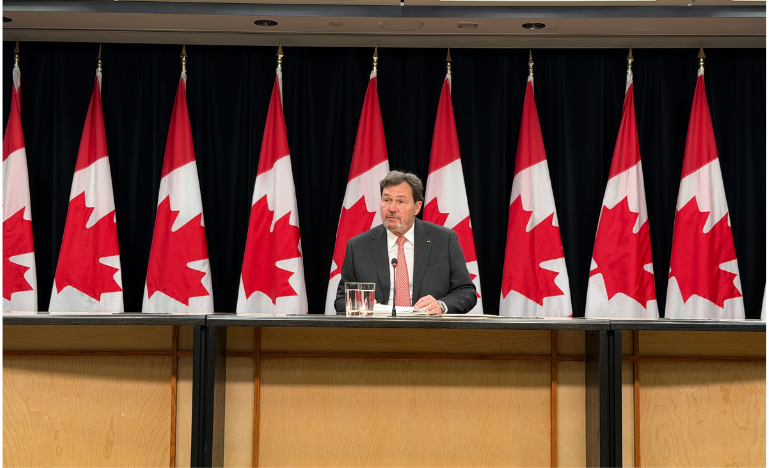
At his annual press conference, Supreme Court of Canada Chief Justice Richard Wagner said trust in institutions cannot be taken for granted and commended judges who have spoken out against attacks on the judiciary.
“As in many other jurisdictions around the world, here too we have seen attempts to undermine public confidence in the justice system,” he said.
“We have seen judges and courts sometimes portrayed as partisan actors, or described as obstacles to the will of the people.”
While he clarified that these remarks were not confined to Canada, he made note of statements by the chief justices in several provinces following political attacks on the judiciary.
“There were strong messages given by the chief justices. It’s their responsibility to speak out about any attacks on judicial independence or the rule of law,” Wagner said.
“I liked the way these chief justices acted. We are far from the situation we’ve seen in other countries, and I’m optimistic about that. The main stakeholders in Canada understand the reason for the separation of powers and the reason for judicial independence.”
He would not comment on Alberta Premier Danielle Smith’s expressed desire to change how federally appointed judges are selected in the province, which is one of the questions in a provincial referendum set for this fall, other than to say, “People deserve an independent judiciary.”
More money
Turning to time, Wagner said that if courts are going to meet the deadlines set out in Jordan, governments will have to provide more resources.
“Society should find the means and the ways to make sure that criminal trials will proceed within the [timeline],” he said.
“With Jordan, that’s a work in progress. We’re going in the right direction, and all kinds of new processes were put in place to facilitate the process of criminal trials in Canada.”
Wagner said all players in the system have contributed to these efforts, and he believes elected officials have gotten the message about properly resourcing justice systems across the country. However, there’s still more to do to ensure criminal proceedings are never stayed because of delays.
Referencing the pair of Jordan-related decisions two weeks ago, Wagner said that one stay is too many.
“I still believe Jordan is the right scheme, even though I was in dissent when the decision was rendered,” he said.
“Now, it’s the law. We still believe that strict [ceilings] were necessary.”
Additional resources will also be needed to address the anxiety and stress judges are facing in light of increasing workloads. Wagner noted the Canadian Judicial Council has completed its study on the health and well-being of judges in Canada, and that the results will be made public in the coming weeks.
“I don’t think there will be any surprises,” he said, noting that in addition to a lack of resources in recent years, slow judicial appointments meant judges had to do the work of two people until they were filled. While that issue has been resolved, the need for investment remains.
Litigants on their own
Regarding other pressures on the system, Wagner raised the issue of the rise in self-represented litigants. The number of people coming before the Court without a lawyer has been increasing since the start of the COVID-19 pandemic. In 2025, they accounted for 37 per cent of all applications to the Court.
“It’s concerning,” he said.
“In the last few weeks and months, it’s risen to 42 per cent.”
While it’s hard to identify a specific reason for the rise beyond costs and delays, Wagner said there may be issues at play they don’t fully understand yet. It’s also happening in courts at all levels, which creates an increased burden on staff to assist self-represented litigants and help them navigate the system.
“We decided that we could not simply dispose of those cases,” he said.
“They have the right to be considered. Unfortunately, most of those cases do not raise a legal issue of public importance. Very often, people don’t know where to go, so they file with the Supreme Court.”
There’s no magic solution, but Wagner said additional efforts are needed to address the influx, including more pro bono services and increased government support for legal aid to help more people exercise their rights when they know about them.
‘Promising and problematic’
Wagner also discussed how technology is changing the legal landscape. He said artificial intelligence is now present in the courtroom in ways that are “both promising and problematic.”
“In terms of the legal world, one survey last year said there were 224 incidents of fake cases raised before the courts in Canada,” he noted.
“That’s the risk of using AI in the courts. The risk is increased when you consider that people without any legal background, such as self-represented litigants, will often use AI to go before the court, because they don’t have the knowledge.”
Wagner said it’s up to law societies to ensure that lawyers, as officers of the court, are always submitting cases that are real. He noted that the Supreme Court has adopted the Canadian Judicial Council’s guidelines on the use of AI by judges. Those permit the technology to be used to summarize documents, but never for analysis or to render judgments.
The case of untranslated historical decisions
As for the issue of translating the Court’s 6000 rulings from before 1970, Wagner noted that a recent decision of the Federal Court agreed with the court registrar’s position that they should not have to translate every decision from before the adoption of the Official Languages Act.
The Court is waiting for the appeal period on that case to close before making any other decisions around restoring the untranslated historical decisions on its website.
As part of the Court’s 150th anniversary activities, 24 historical decisions were selected for translation. Wagner said that while one has been posted online, nine more have been completed and will be uploaded shortly.
On the move
Efforts are underway to move the Court to its new temporary home at Ottawa’s West Memorial Building, a block away from its permanent home, which Wagner described as a huge logistical challenge.
With that work to take place over the summer, things will be ready for the ceremonial opening of the Court’s judicial year in the new building on October 5.