Members
Kids taking Carney government to court
Along with advocacy groups, the youth claim environmental policy rollbacks mean the feds no longer have a credible plan to meet legally binding 2030 climate targets
BY Holly Lake 16 Jun. 2026

Log in to listen to this article
The kids are taking the federal government to court for gutting Canada’s key climate policies.
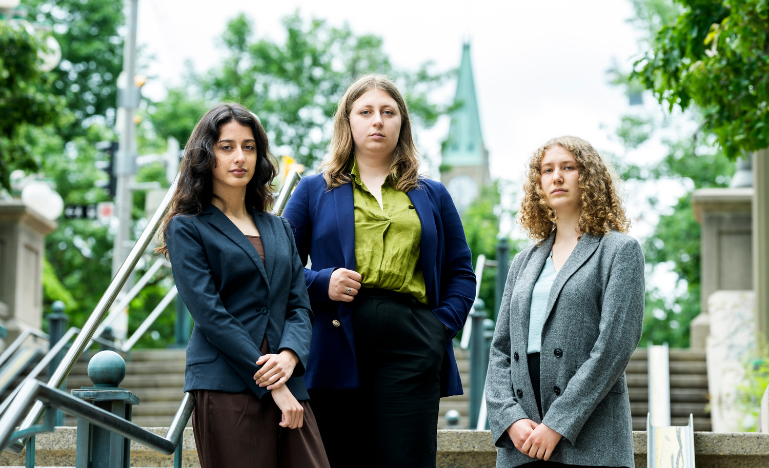
Sophia Mathur from Sudbury, Ont., is among them. When she met Prime Minister Mark Carney, she asked him to keep the climate promises his government made to Canadians. Then last November, she says he pledged before Parliament that his government would respect Canada's 2030 emissions target.
“Thousands of Canadians saw that pledge and wanted to believe those promises,” she told reporters on Parliament Hill Tuesday.
“For my entire life, governments have told young people that climate action is a priority. We've heard it in speeches, during election campaigns, we've heard promise after promise, but promises without a plan are not enough.”
When political leaders insist they’re committed to climate action while simultaneously dismantling the policies needed to achieve it, Mathur says young people notice.
“We are the ones who will be facing and living with the consequences of that, and that is why I'm here today.”
Her generation's first decades on this planet have been marked by wildfire seasons, floods, heat waves, and warnings from scientists that the window for action is closing.
“Prime Minister Mark Carney, the tragedy of climate change is not on the distant horizon. It is something that we are facing right now,” she says.
The case, filed in Federal Court on June 15, was launched by Ecojustice on behalf of Mathur, Marie Maltais, Shirley Barnea, the Canadian Association of Physicians for the Environment (CAPE), and Environmental Defence. It alleges that the federal government’s comprehensive rollbacks of key measures in the federal climate plan violate the Canadian Net-Zero Emissions Accountability Act (CNZEAA).
“Prime Minister Mark Carney has said that climate action is a moral duty and an economic imperative, and we agree it is both of those things,” Charlie Hatt, Ecojustice’s climate program director, told Tuesday’s press conference.
“But it's also something more. It is a legal obligation.”
CNZEAA requires the federal government to set science-based climate targets, develop a credible plan to meet them, and report to Canadians on progress. Hatt says its purpose is to drive the actions that will protect people and the environment from the growing harms of climate change, such as heat waves, wildfires, and flooding.
But over the last year, he says the Carney government has weakened, delayed, and repealed Canada's key climate policies without identifying credible alternatives to make up the gap, all while doubling down on a future powered by fossil fuels. The environmental rollbacks include lowering the industrial carbon price, weakening clean electricity regulations, and proposing reforms that would gut the processes meant to protect species at risk and ensure citizens are informed about projects’ impacts.
As a result, Hatt says even if Canada’s climate plans, as they were last December, were fully implemented, they would at best reduce this country’s emissions by 21 – 28 per cent in 2030. That misses Canada’s legally mandated 2030 target by 90 to 140 million tonnes of climate-fueling carbon emissions. Since the end of last year, weakening policy has widened that gap.
He says they’re asking the court to order the federal government to amend the 2030 climate plan to describe the key measures the government intends to take to achieve Canada's 2030 emissions target.
“In short, we're asking for a plan to achieve the target, not a plan to fail. It is time for accountability before the law.”
'Hope is not a plan'
Shirley Barnea of Montreal says three years ago, Quebec was overwhelmed by its worst wildfire season in recorded history, sparked by dry conditions and made twice as likely by climate change. For days, wildfire smoke made Montreal the city with the worst air quality in the world. Ultimately, an area the size of Denmark was burned, costing the federal government $1.1 billion.
“Many of us looked to Prime Minister Carney's government for a sign they would take our security seriously,” she says.
Instead, climate policies have been scrapped or weakened, and the consensus among experts is that 2030 targets are out of reach, which she described as a “massive insult.”
“After presenting himself as a climate leader, our prime minister is now abdicating responsibility — to Canadians, to future generations, to the law,” Barnea says.
“As long as governments continue ignoring climate science and rolling back protections for our futures, young people will continue taking them to court.”
Quebec-based youth Marie Maltais says while they’re told to trust the government’s climate commitments, those mean nothing without a real plan behind them.
“Hope is not a plan, and nostalgia is not a strategy,” she says, quoting the words Carney delivered at the World Economic Forum in Davos earlier this year.
It’s not the first time Mathur has taken a government to court. In 2019, at the age of 12, she was one of seven youth who made Canadian legal history when they took the Ontario government to court for slashing its climate targets. The historic constitutional challenge focused on the province’s reduced greenhouse gas emission targets. In 2024, the Ontario Court of Appeal found that Ontario’s climate action is subject to the Charter of Rights and Freedoms.
In May 2025, the Supreme Court of Canada rejected the province's appeal of that decision and sent the matter back to the Ontario Superior Court to be decided on its merits.
“The young people standing here should not have to be in court demanding a lawful climate plan,” says Julia Levin, the associate director, national climate at Environmental Defence Canada.
“Neither should we, as climate experts, but Prime Minister Carney has shut experts out from his decision-making and is clearly not listening to those within his government when they raise concerns. We have been left with no other option. When governments abandon their responsibilities, we have every right and every reason to fight back and protect what we love.”
When asked about the federal government’s response to allegations it has failed to meet its climate obligations and broken promises to Canadian youth, Keean Nembhard, press secretary for the minister of environment, climate change, and nature, said they “are aware of the recent court challenge.”
“The Government of Canada is committed to fighting climate change and reaching net-zero emissions by 2050. We will continue working to build a clean, low-carbon, and resilient country,” he said in an emailed statement.
“As this matter is before the courts, we cannot comment further."