Members
‘Criminal conduct no less criminal during lawful protest’
Failing to limit it puts everyone’s Charter rights at risk
BY Jody Berkes 30 Jul. 2026

Log in to listen to this article
Various groups claiming to be engaged in lawful protest have taken over our streets, neighbourhoods, parks and campuses. Protesters intimidate, harass and exclude others, while claiming their Charter right to “free expression and peaceful assembly” prevents police from laying charges.
To date, various police forces have tacitly agreed, limiting charges to actual physical violence or threats. Lax enforcement has emboldened protesters, leading to groups marching in residential neighbourhoods, chanting hateful rhetoric.
The Ontario Court of Appeal recently made an important statement in R. v. King, which should end the notion that, during a protest, police cannot charge protesters absent actual violence.
“Put simply, criminal conduct is not less criminal because it occurs during a lawful protest,” it stated.
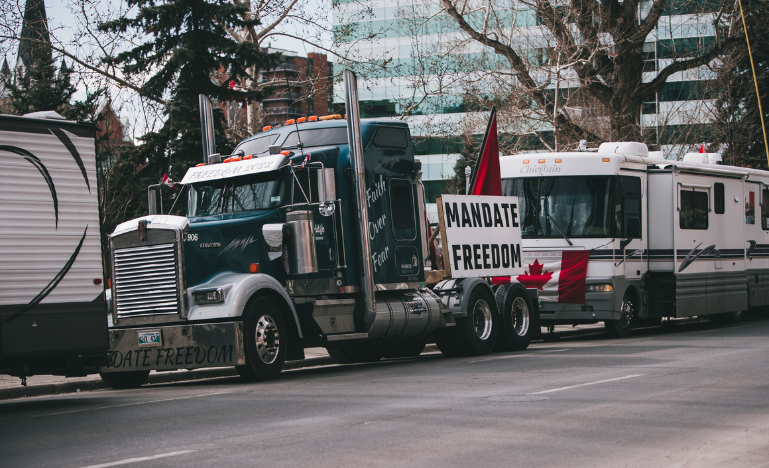
Pat King was a leader in the trucker convoy that blockaded Ottawa for weeks in January 2022. At trial, he was acquitted of intimidation by obstructing a highway under section 423 of the Criminal Code. The judge reasoned that King did not intend to intimidate because he did not use threats or acts of violence to obstruct the highway. Furthermore, convicting him in the absence of threats or violence could stifle lawful protest.
The Court of Appeal overturned King’s acquittal and substituted a conviction. It found that section 423 did not require acts of violence to cause the highway obstruction, and that the trial judge erred by adding that element. The Court also said that by its very nature, obstructing a highway is intended to intimidate others.
“Mass obstruction of public highways is not a form of peaceful protest. The fundamental freedoms of expression and assembly do not encompass obstructing public highways, or inciting anyone else to do so,” it stated.
What does the decision mean for protests?
First, the fact that people are engaged in Charter-protected protest does not excuse criminal behaviour. Enforcing the law during protests will not chill free speech. Consistent enforcement will ensure that anyone opposing protesters has an equal right to exercise their Charter rights.
Second, the police should not require overt acts of violence or threats before charging protesters with appropriate offences, even while engaged in lawful protest.
For example, the criminal offence of unlawful assembly under section 63 of the Criminal Code does not require proof that protestors used explicit threats or violence. It simply requires that people in the neighbourhood reasonably fear that the assembly will become loud and boisterous, disturbing nearby residents. When protesters shout hateful rhetoric while marching up and down streets beside residential homes, grocery stores, houses of worship, parks and community centres, it’s hard to imagine how anyone could not fear they’d disturb the peace.
The police have regularly allowed this to occur based on a belief that, unless there is an overt act of violence, an unlawful assembly has not taken place. The Court of Appeal’s decision in King should finally put this misconception to rest. There are other parts of a city where this behaviour can lawfully take place, just not the residential parts.
If this behaviour occurred in front of a provincial legislature, city hall, university campus, or another space designed for large public gatherings, it would be less likely to run afoul of section 63. However, even during lawful protests in public spaces, the criminal law must be enforced.
Journalists (both legacy and independent), as well as other members of the public, have a right to be in public spaces while a lawful protest is taking place. They have a right to watch, document, and counter-protest without being assaulted.
During protests, police often require physical contact before charging a party with assault. However, under the Criminal Code, assault can be made out in one of three ways: application of force without consent; gesturing in a manner that causes one to believe a person will apply force to them; or, while carrying a weapon, impeding another party’s travel.
So, coming right up into someone's face and putting your hand up in front of them is an assault just the same as if you laid a hand on them. Blocking their path with a flagpole is also an assault. Under the Code, anything that can be used to assault someone is a weapon. The police must enforce these laws.
Similarly, the offence of mischief prohibits obstructing, interrupting, or interfering with anyone’s lawful use, enjoyment or operation of property.
People have the right to film in public spaces. Protestors cannot assault, menace, or use objects to block someone exercising their right to videotape a protest in public. It is also an offence to block someone from walking around in public spaces because you disagree with their point of view.
Intimidating by nature
Finally, as the Court stated in King, blocking a highway, whether for protest or prayer, is, by its nature, intimidating to the public.
The current enforcement climate has enabled unremitting criminal activity under the guise of lawful protests. The police escort protesters roaming through residential neighbourhoods, harassing residents, blocking roads, sidewalks, parks, and businesses under the notion that they are keeping the peace. What the police are doing is facilitating street harassment of residents in those neighbourhoods.
Consistent, unbiased enforcement of the law is necessary to ensure all members of the public, regardless of the acceptance or righteousness of their views, are equally able to exercise their right to free expression and assembly. Failing to enforce the criminal law out of a misinterpretation of what constitutes violence, or a fear of protesters labelling police as racist, is wrong.
In promoting section 2 of the Charter, we may forget that section 1 maintains that rights can be limited in a free and democratic society. Those limits are criminal activity, even when it occurs during a lawful protest. If we fail to enforce those limits, we risk everyone's Charter rights.
* Views expressed are not necessarily those of the Canadian Bar Association.