Members
First Innu lawyer called to the bar in Newfoundland and Labrador
Jolene Ashini wants to make legal help accessible for Innu people on their terms and in their language, and to codify ancient legal principles, many of which have been passed down through legends
BY Sue Bailey 26 Jun. 2026

Log in to listen to this article
Two worlds united as Jolene Ashini was called to the bar in Labrador, wearing a ribbon skirt and beaded caribou skin moccasins.
She made history in May, becoming the first Innu lawyer in the place her people call Nitassinan, “our land,” and the first Innu lawyer called to the bar in the province.
At Ashini’s request, it was also the first call ceremony ever held in Labrador, rather than at the usual location in St. John’s.
“I wanted to be able to wear the robes but also make them Innu,” says Ashini, an associate with Aboriginal law specialists Olthuis Kleer Townshend LLP.
“I am so grateful, not only to be able to get called in Labrador, but to also be able to wear Innu things. For me, it was something that I will constantly hold very tight to my heart.”
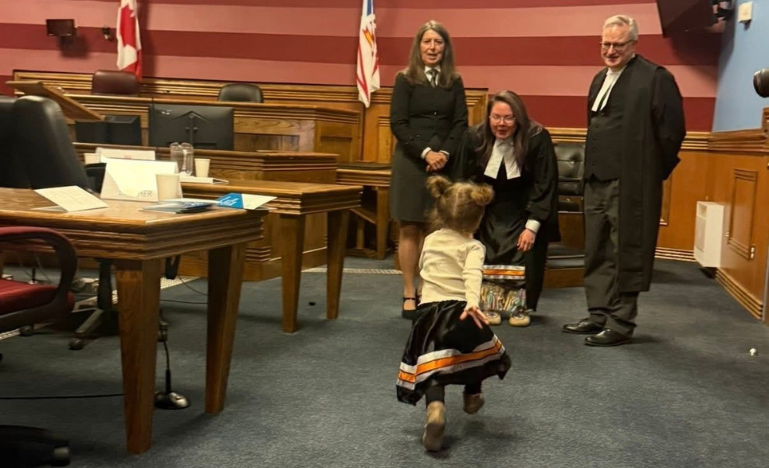 Mina Campbell Photo
Brenda Grimes, executive director of the Law Society of Newfoundland and Labrador, was happy to honour the request.
“When people see themselves represented within the profession, it helps build trust in legal institutions and demonstrates that the profession is open to and enriched by individuals from all backgrounds and all regions of the province,” she said in a statement.
Grand Chief Simon Pokue describes Ashini’s call to the bar as a proud moment for the Innu Nation.
“She is helping open doors for future generations of Innu youth. Her achievement reflects not only her own hard work and dedication, but also the strength and potential of our people,” he says.
“Her success demonstrates that Innu students can pursue careers in law and other professions while remaining connected to their culture, language, and community.”
Ashini also represents the growing presence of Innu professionals in fields that have historically had little Indigenous representation. Pokue says as late as 1968, the Innu of Labrador were still settling into communities, and their opportunities for education beyond residential or day schools were limited.
Raised around advocacy
Ashini, a member of the Sheshatshiu Innu First Nation, is the daughter of the late Daniel Ashini, a renowned land rights negotiator, political activist, and former president of the Innu Nation.
Visiting lawyers working with her father often gathered in their Sheshatshiu home. They spent long hours on files ranging from land claims to benefits deals meant to help compensate the Innu for the development of the Voisey’s Bay nickel mine.
Daniel Ashini instilled in his daughter a deep love of the natural world.
“My sister and I were raised on the land,” Ashini says. “We grew up learning about Innu biology and geology, according to our elders.”
Law school was always an aspiration, but after she was elected to her First Nation’s band council in 2010, she felt it was a necessity.
“I had been sitting across from representatives of other governments and thinking to myself: ‘Nobody's going to take us seriously unless we have the same education as they do.’”
Ashini took a brief but satisfying detour, graduating in 2016 from Acadia University with a bachelor of science in geology. Her research often focused on social and environmental impacts, and she completed a contract with Vale at Voisey’s Bay.
Law school still beckoned, but she knew that a designation in Aboriginal law, rooted in colonial frameworks, was not the path for her.
“For thousands of years, the Innu before contact have been living and governing themselves,” Ashini says.
“Indigenous Peoples across Canada have had this completely foreign legal norm imposed on them, which meant, what, their laws are inferior? They’re not inferior.”
The blended approach she sought suddenly became an option in 2018, as the University of Victoria introduced its groundbreaking joint-degree law program in common law and Indigenous legal orders.
The four-year program is a direct response to one of the Truth and Reconciliation Commission’s 94 Calls to Action. It allows students to earn the two professional degrees simultaneously.
Ashini applied before even taking the LSAT and was among the first cohort to graduate. She won the inaugural Justice Rosalie Silberman Abella Prize in 2022, given by the Royal Society of Canada to graduating law students most likely to advance equity and social justice.
She was first called to the bar in Ontario two years ago.
As a summer student with Toronto-based Olthuis Kleer Townshend, Ashini helped represent the Innu Nation at the ongoing public Inquiry Respecting the Treatment, Experiences and Outcomes of Innu in the Child Protection System.
“I had seen the harms caused,” she says. “I had seen people suffering in certain situations that the inquiry is now coming to understand. These are the issues that are really important to me now.”
Ashini’s devotion extends to her personal life. She and her partner, Joshua Major, are raising their young daughter, Alita, in Labrador after stepping in as foster parents when Alita was less than a year old.
“She is the biological half-sister of my niece, whom my sister and her husband adopted.”
The baby was at risk of being removed from the community for care.
“We knew we couldn’t separate our little girl from her sister and the rest of her family.”
Making the law accessible
Ashini wants to make legal help accessible for Innu people on their terms, in their Innu-aimun language. Those efforts will include drafting laws for taking over child welfare jurisdiction.
She will also focus on codifying ancient legal principles, many of them passed down through Innu legends.
There are laws in those lessons that are more fluid and context-based than typically found in common law, Ashini says.
Extensive archives of interviews with Innu elders will guide that work.
“The Innu know that we can’t go back to living nomadically anymore. We have to adjust our laws to fit how we live now,” she says.
“I want to try to make sure that our ideas and rules of being and living continue on. Our history can be erased just like that.”
Her point was underscored earlier this month as the Innu cancelled a cultural exhibit called Innu Pakassiun – a reference to survival tools – saying the province tried to limit the Innu historical timeline in Labrador to 300 years. Premier Tony Wakeham apologized, but the resulting backlash is far from resolved.
John Olthuis, a founding partner of Olthuis Kleer Townshend, has been working to advance Indigenous rights and land claims for 50 years. He often visited Ashini’s childhood home while working with her father.
“She beamed with intellect, curiosity and caring, so it was not a surprise to me that she became such a star pupil.”
His most recent book, On Dismantling Settler Colonialism: An Insider’s Perspective on Reconciliation with Indigenous Peoples, came out last year.
Olthuis believes change is slow but inevitable. To achieve it, Indigenous and non-Indigenous lawyers must collaborate to chip away at colonial structures while reconstructing Indigenous traditions.
“It’s becoming more and more difficult for the colonial legal system to maintain itself,” he says.
“The more the alternative Indigenous approach to particular issues is put before the courts, the more attention judges pay to it.
“The hope is in young lawyers like Jolene to continue to work at that.”
Whether it’s Aboriginal rights, self-government, land claims, resource development, child welfare, education, or the protection of language and culture, Pokue says having Innu lawyers involved brings valuable perspectives and lived experience to the discussions.
“Jolene's call to the bar is particularly significant because it comes at a time when Innu are seeking to ensure our voices are represented within decision-making processes."
Ashini carries the weight of that responsibility to her First Nation and as a role model for its youngest members.
Getting out on the land to hike or pitch a tent is how she truly regroups. She also finds inspiration as a watercolour artist.
“Whatever bar I set, I want it to be exceeded,” she says.
“I am trying my best to show Innu youth that anything is possible. There’s a whole community of people out there cheering you on when you’re at your lowest moment.”